One requirements baseline. Eight connected deliverables.
Inspect the files your team can use in its own implementation workflow. The delivered package stays usable without an Aimspace portal after handoff.
Fictional examples, not customer work.
Files and formats
Explore the deliverables
Standard contents
Business need, problem statement, and intended outcomes
Objectives, success measures, and target state
Scope, boundaries, and material exclusions
Stakeholders, roles, and evidence coverage
Current-state findings, pain points, and operating context
High-level business requirements and priorities
Constraints, assumptions, and dependencies
Key risks, issues, open questions, and decisions
Review status, unresolved items, and approval-ready position
Illustrative file preview
Existing two-page fictional BRD. Its older survey and outline-review language describes this illustrative scenario.
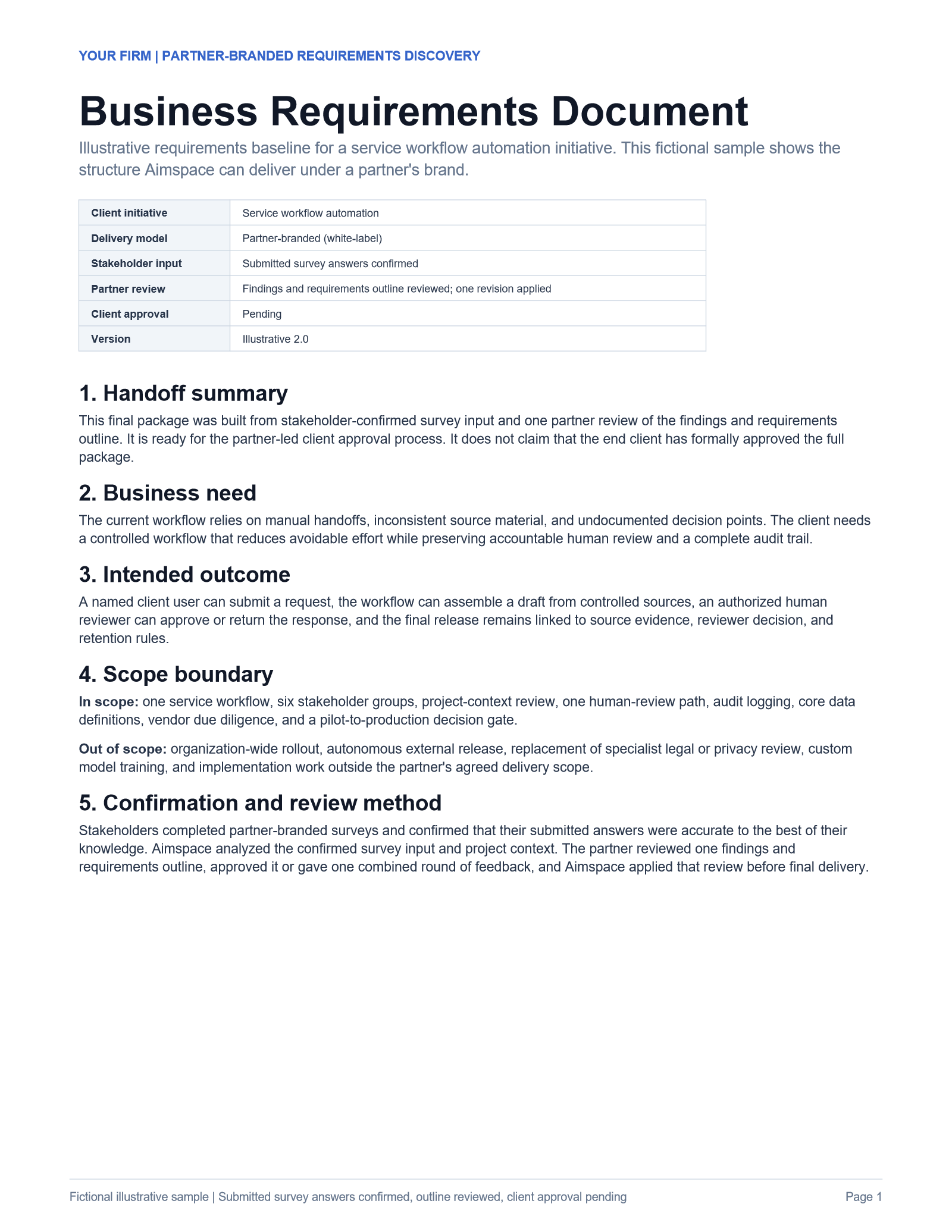
Business Requirements Document, page 1 of 2
Standard contents
Stable requirement IDs, categories, and clear requirement statements
Business, functional, and non-functional requirements
Business rules and policy-driven requirements
Data, reporting, interface, and integration requirements where applicable
Transition, migration, and operational requirements where applicable
Rationale, source, owner, and stakeholder linkage
Priority, status, assumptions, constraints, and dependencies
Acceptance criteria and measurable completion conditions
Open questions, exceptions, and partner review status
Illustrative file preview
Six requirements in the Requirements worksheet of one combined workbook. This is a limited illustrative baseline.

Combined workbook: Requirements, A1:I7
PDF sample is not yet available.
Standard contents
Requirement ID and requirement type
AI interview, meeting transcript, and project-document source links where used
Business objective and parent-requirement linkage
Related business rules, data concepts, and interfaces where applicable
Requirement-to-requirement dependencies
Acceptance and validation linkage
Review and status fields
Coverage gaps, unresolved links, and change-impact visibility
Illustrative file preview
Traceability worksheet in the same combined workbook: six source, stakeholder, objective and dependency entries. It is not a separate RTM file.

Combined workbook: Traceability, A1:F7
CSV sample is not yet available.
Standard contents
Controlled business terms and definitions
Data concepts, entities, and field definitions where applicable
Data type, format, allowed values, and validation rules where known
Source and target systems where applicable
Business rules and interpretation notes
Owner or accountable role
Related requirement IDs and source references
Status, open definitions, and unresolved terminology
Illustrative file preview
Glossary worksheet in the same combined workbook. Three terms illustrate terminology coverage; no detailed field dictionary is included.

Combined workbook: Glossary, A1:E4
PDF sample is not yet available.
Standard contents
Risks with impact, ownership, mitigation, and status
Assumptions with evidence or validation status
Issues with owner, action, and resolution status
Dependencies with owner, timing, and affected requirements
Decisions with rationale, decision owner, date, and affected scope
Open questions and actions requiring resolution
Cross-links to relevant requirements and source evidence
Current status and target dates where applicable
Illustrative file preview
RAID and Decisions worksheet in the same combined workbook: four illustrative risk, assumption, issue and decision entries.

Combined workbook: RAID and Decisions, A1:G5
PDF sample is not yet available.
Standard contents
Stakeholder discovery completion, source type, and confirmation status where applicable
Evidence and input coverage summary
Requirements version and team review status
Partner comments, corrections, and material changes
Open exceptions, unresolved questions, and pending decisions
Final revision and handoff status
Client approval fields, authority, and status placeholders
Clear distinction between source linkage, AI-interview confirmation, team review, and formal approval
Illustrative file preview
Approval worksheet in the same combined workbook. Four entries distinguish source confirmation, Partner Review, pending formal approval and an open exception.

Combined workbook: Approval, A1:D5
PDF sample is not yet available.
Standard contents
Backlog item ID and linked requirement IDs
Clear work item or user-story statement
Acceptance checks carried forward from the requirements baseline
Priority, status, owner, and delivery notes where known
Dependencies, constraints, and related decisions
Source and traceability links back to the controlled requirements
Open questions or blockers that must be resolved before build
Structured XLSX and CSV fields ready for tracker mapping or import
A public sample file is not yet available for this deliverable.
Standard contents
Business problem, intended outcome, and agreed scope
Most important findings and requirements themes
Key decisions, assumptions, constraints, and dependencies
Material risks and unresolved issues
Important open questions and who needs to answer them
Readiness for design, build, and client approval steps
Clear next actions for the partner and client
Plain-language executive summary suitable for partner-led client handoff
A public sample file is not yet available for this deliverable.
Requirements and findings link to their sources; Aimspace-derived or recommended requirements are labelled. The package records source confirmation, team review, and formal client approval separately.
Raw AI-interview responses and supplied meeting transcripts are not standard final deliverables. Any release is handled separately under the engagement, privacy, and data-handling terms.
How review and approval work